Lab No. 1 - Buoyancy and Archimedes' Principle Lab

Objectives

  • Study the relationship between the volume of water displaced by a submerged object and the buoyant force.
  • Employing Archimedes' Principle determine the unknown density of an object.

Physics Overview

Archimedes' Principle states that the buoyant force that a submegred body feels is equal to the weight of the water (or fluid) that it displaces. This is a direct consequence of the fact that the pressure in a fluid varies with depth.


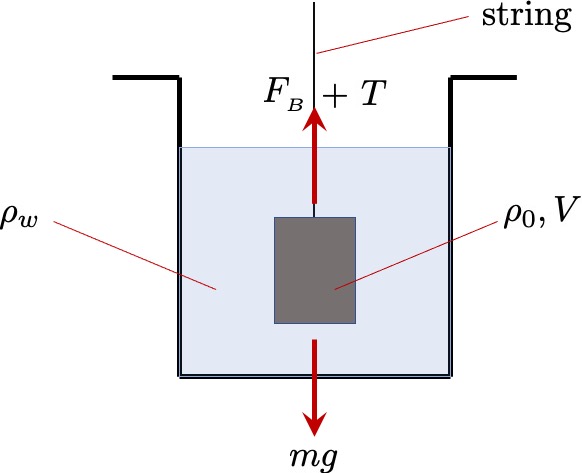
Consider a mass \(m\) suspended in a beaker of water with the aid of a string as shown in Fig. 1. The density of water is \(\rho_w\). The density of the mass is \( \rho_0\), and it has a volume \( V\), both of which are as yet unknown quantities.

a pebble suspended in a can of water

Fig. 1: A mass \(m\) suspended in a beaker of water with the aid of a string. The volume of the mass is \(V\) and it has a uniform density \(\rho_0\). The tension in the string is \(T\).

If the mass in Fig. 1 is in equilibrium then the sum of forces acting on it must be zero. Therefore we can write:


\[ F_{_B} + T = mg \label{eq:force_bal}\]


Since the density of the mass is \(\rho_0\) and the volume \(V\), we can write:


\[ \rho_0 V g = mg \label{eq:mass_weight}\]


Now, according to Archimedes's principle the buoyant force experienced by a submerged object is equal to the weight of the fluid dispersed. In Fig. 1 the volume of the fluid displaced is essentially the volume of the mass \(V\), therefore we can write:


\[ F_{_B} = \rho_w V g \label{eq:buoyant_force}\]


Substituting Eqs. \eqref{eq:mass_weight} and \eqref{eq:buoyant_force} into Eq. \eqref{eq:force_bal} we get:


\[ \rho_w V g + T = \rho_0 V g \label{eq:force_bal2}\]


If we are able to measure the tension (\(T\)) in the string somehow as well as determine the unknown value for the volume (\(V\)) then we can determine the unknown density \(\rho_0\)


If you would like to learn more about buoyancy and Archimedes' Principle, see the following video.

Apparatus

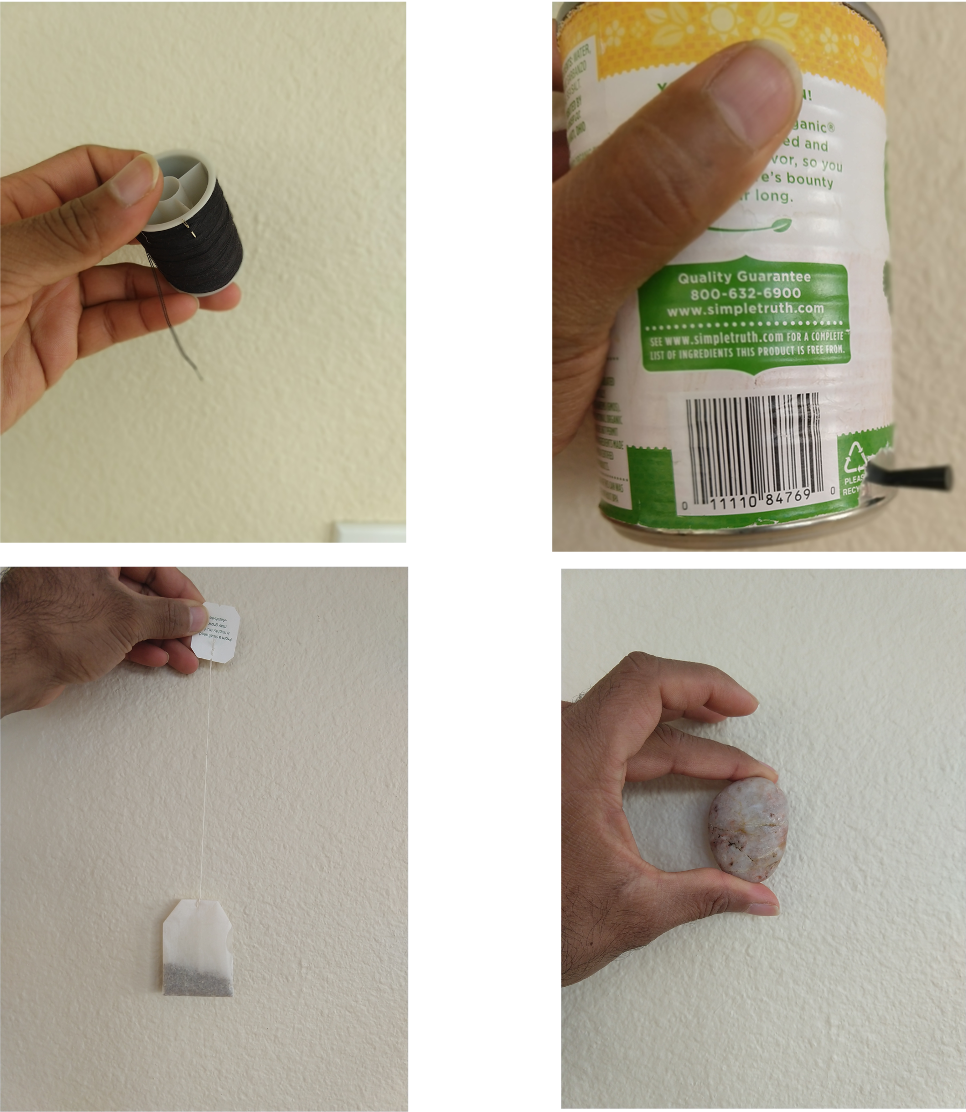
For carrying out the experiment you will need the following equipment (see Fig. 2):

  • iOLab Device and corresponding USB Dongle.
  • A computer with iOLab data logging software installed.
  • A number of books.
  • A tea bag with string.
  • Scotch tape.
  • A small pebble or a rock.
  • A can with a small hole at the bottom.
  • A rubber stopper.
  • Some water.

Please note: DO NOT disassemble the apparatus once you have put it together as you will need the same apparatus for Lab No. 2 for the Bernoulli's Equation Lab.


apparatus for equipment

Fig. 2: Figure showing apparatus needed for carrying out the Buoyancy and Archimedes' Principle lab. Clockwise from the top left: some thread, e.g. sewing thread will suffice, a can with a small hole at the bottom with a rubber stopper inserted, a small pebble or rock, a tea bag.

Give it a go!

give_it_a_go

Procedure

The procedure to be followed for doing the experiment is given below:


Part - I (Determine the string tension without buoyancy):


  1. Cut open the tea bag at the bottom of the tea bag and empty out the tea.
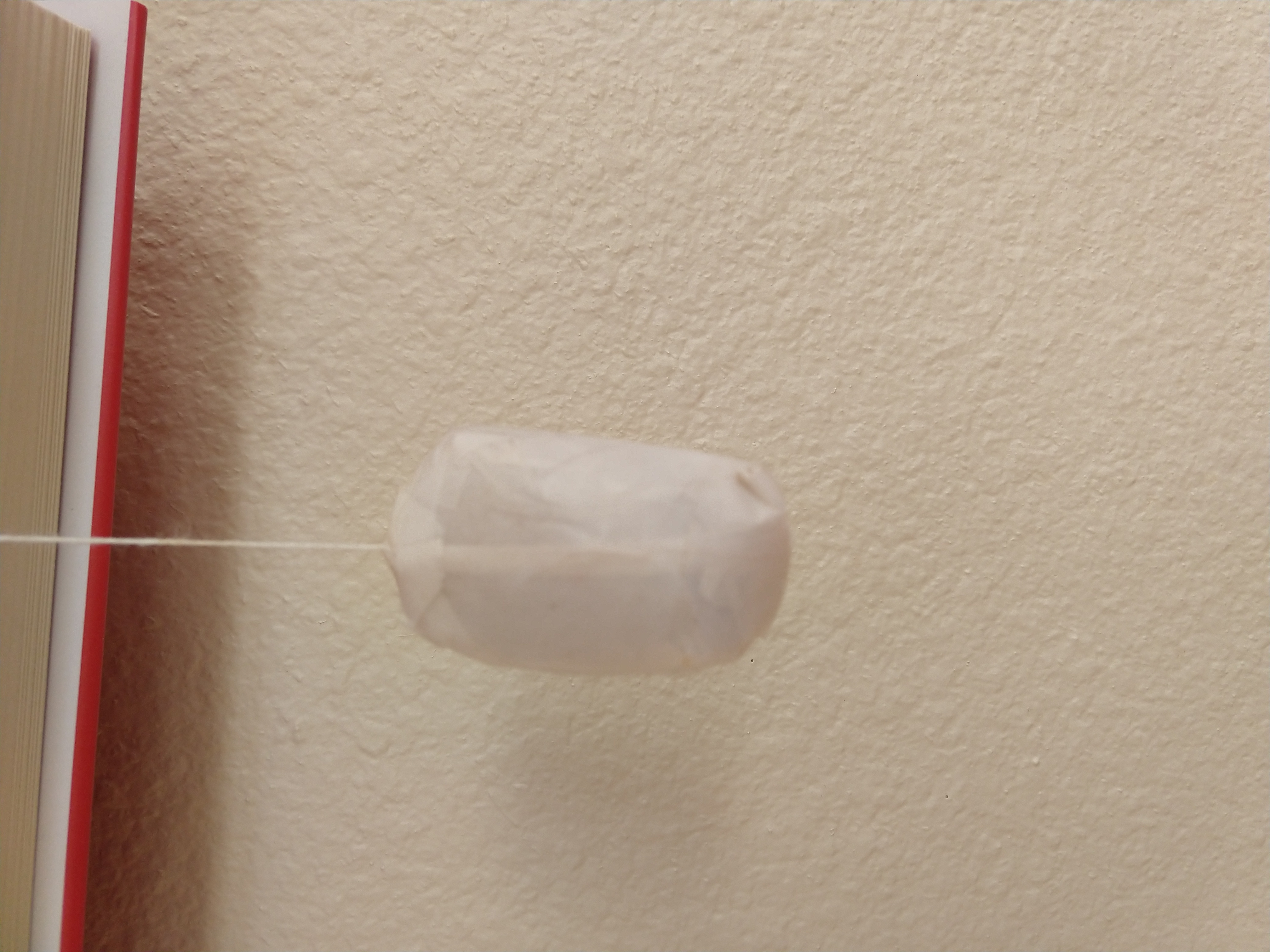
  2. Insert the small pebble into the tea bag and tape over with a scotch tape generously to fully enclose the pebble; see Fig. 3. When done, your pebble should be housed snugly inside the tea bag and the tape should render the tea bag water-proof.
  3. Find a suitable table with a relatively flat top.
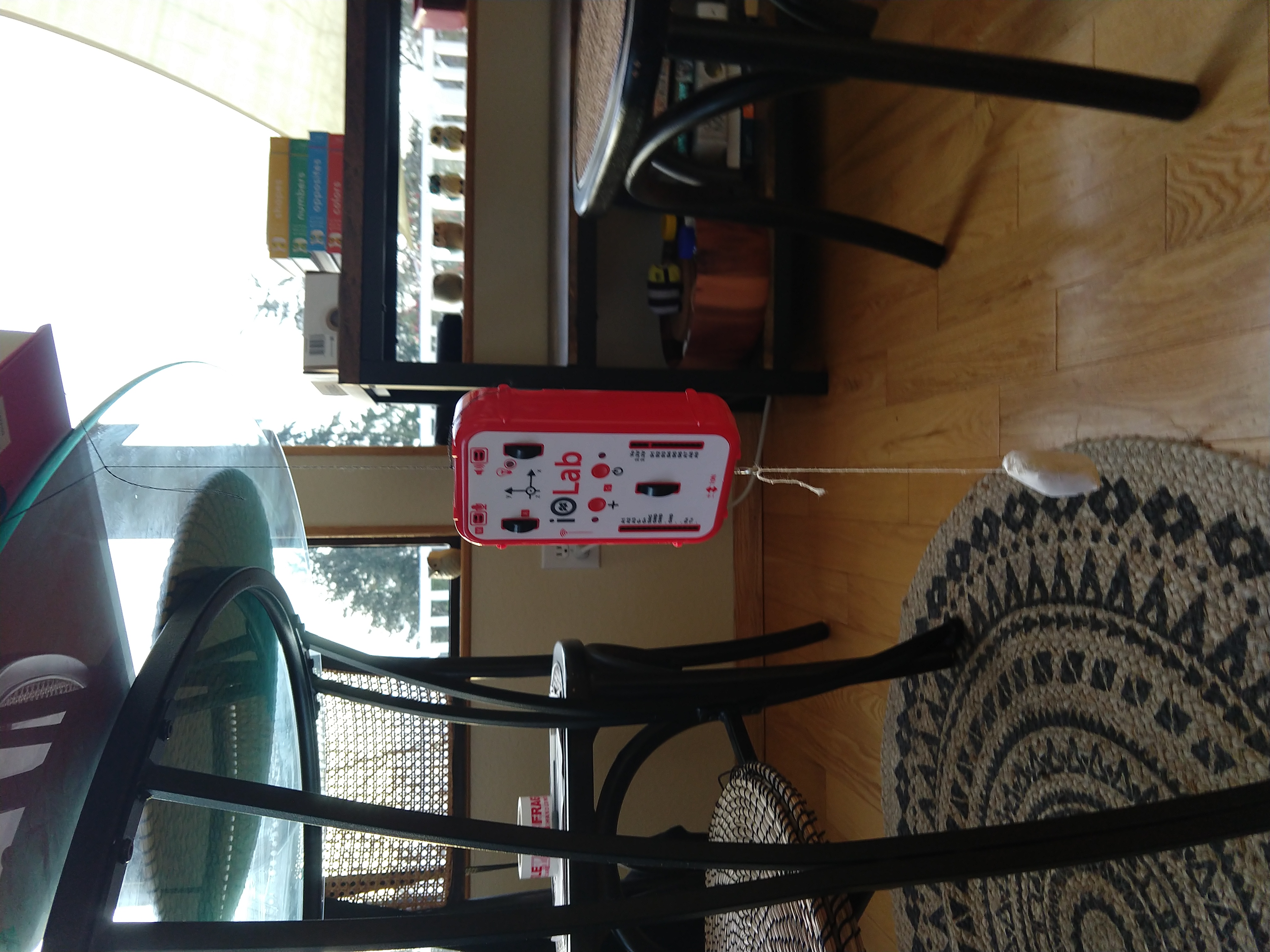
  4. Next tie a piece of string about \(15~\textrm{cm}\) long to top of the iOLab device. At the bottom of the iOLab device attach the eye bolt to the force probe. Refer to Fig. 4.
  5. Next find a suitable hardbound book, one which is at least \(4-5~\textrm{cm}\) thick and at least \(25~\textrm{cm}\) long.
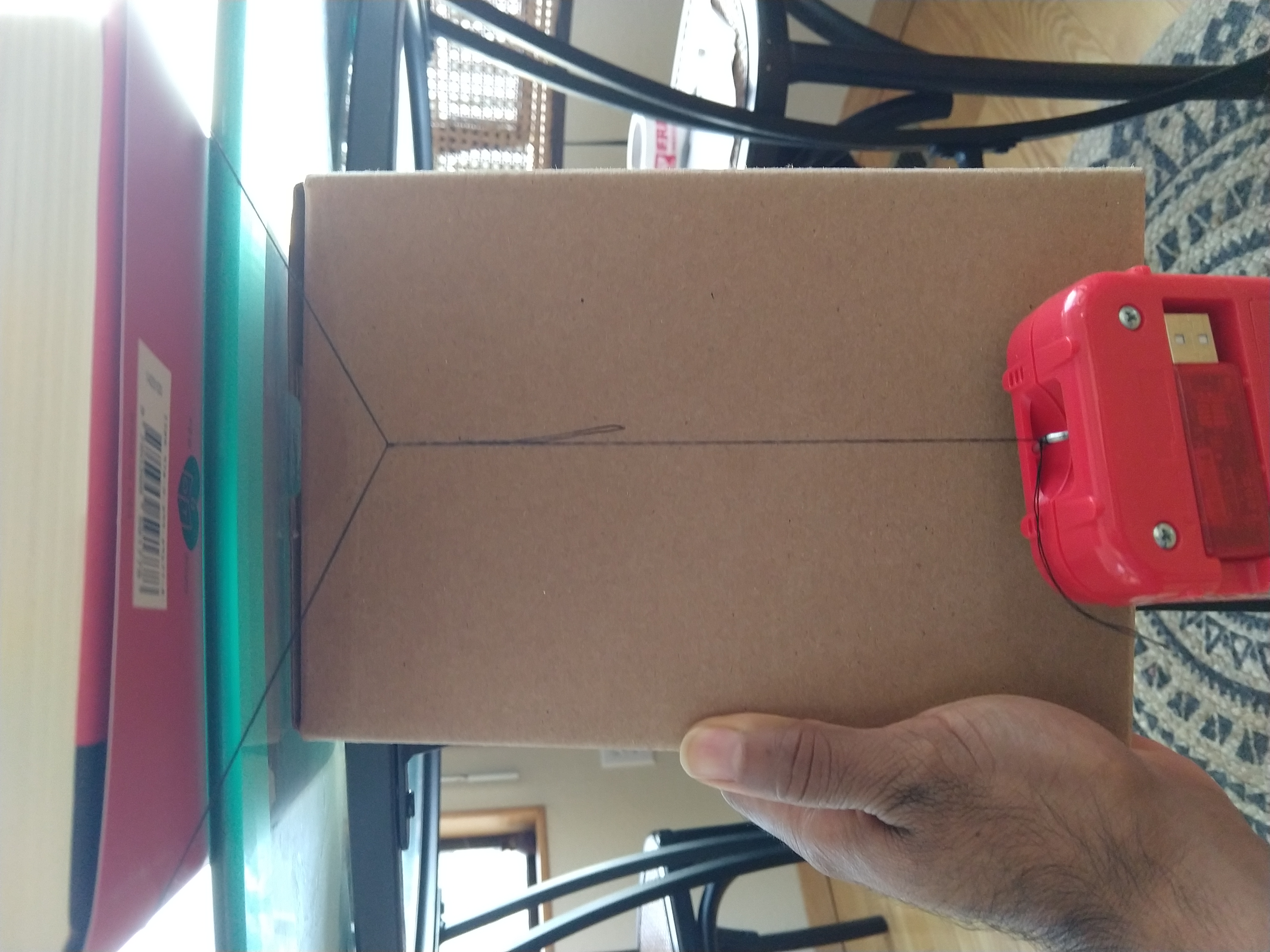
  6. Tie a loop of string about one end of the book. Refer to Fig. 4.
  7. Attach the loose end of the string which is attached to the top of the iOLab device to the loop of string which is tied around one end of the book (see Fig. 4). Ultimately, you must be able to suspend your iOLab device as shown in Fig. 4. When properly suspended, the strings should form a "Y" shape as can be seen in Fig. 4.
  8. Finally attach the tea bag string that holds the pebble to the eye bolt at the bottom of the iOLab device as shown in Fig. 5.
  9. Place the book with the iOLab device attached to it over the edge of the table as shown in Fig. 4, so that the iOLab device is suspended, and the pebble is in turn suspended from the eye bolt at the bottom of the device.
  10. Allow the iOLab device to become stationary, then gently turn it on and record data using the force sensor. Record data for about \(10\) seconds.

wrapped pebble

Fig. 3: A pebble inserted into a tea bag and wrapped with scotch tape.

how to suspend the iolab device

Fig. 4: Image showing how to suspend the iOLab with the aid of some string and a book.

suspended pebble

Fig. 5: Image showing how to suspend the pebble from the iOLab device.


Part - II (Determining the string tension with buoyancy):


  1. Place the empty can with the stopper on the floor directly beneath the suspended pebble.
  2. Raise the height of the can with the aid of books placed underneath the can to raise it enough such that the pebble is fully inside the can and suspended approximately in the centre of the can; see Fig. 6.
  3. Now fill the can with water until the pebble is fully submerged.
  4. Turn the iOLab device on and select the force probe on the iOLab software. Record data for about \(10\) seconds.

suspended pebble

Fig. 6: Image showing how to suspend the pebble such that it is submerged inside the water in the can.

Data Analysis


The following video shows how to analyse the collected data for determining the string tension when buoyancy is absent:


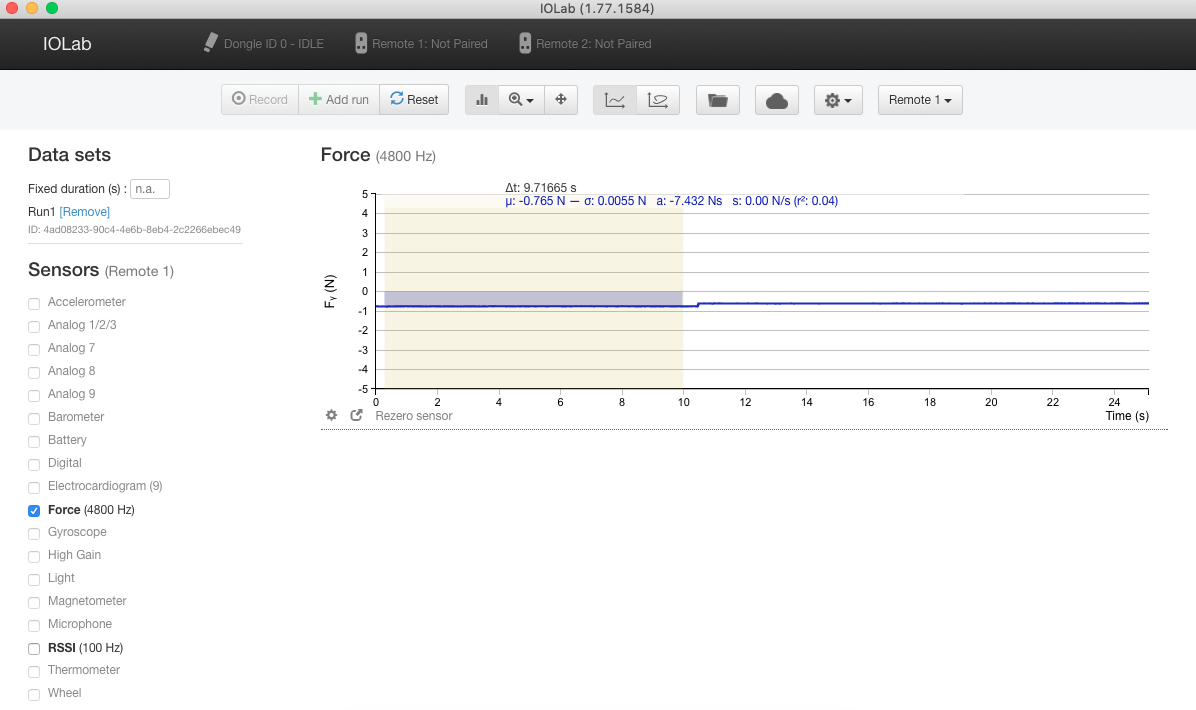
When the pebble is simply suspended then the tension in the string, which is the reading from the force sensor, is equal to the weight of the pebble. We can write:


\[T^\prime = \rho_0 V g \label{eq:Tprime}\]

Currently, both the volume (\(V\)) and the density (\(\rho_0\)) are unknown.


Figure 7 below shows how to determine the average value of the tension in the string by selecting the appropriate portion of the data from the force sensor reading:

determining tension as the average value of the force sensor reading

Fig 7: Select a large flat portion of the force data. The average value for the force is the tension in the string \(T^\prime\).

The following video shows how to analyse the collected data for determining the string tension when buoyancy is present:


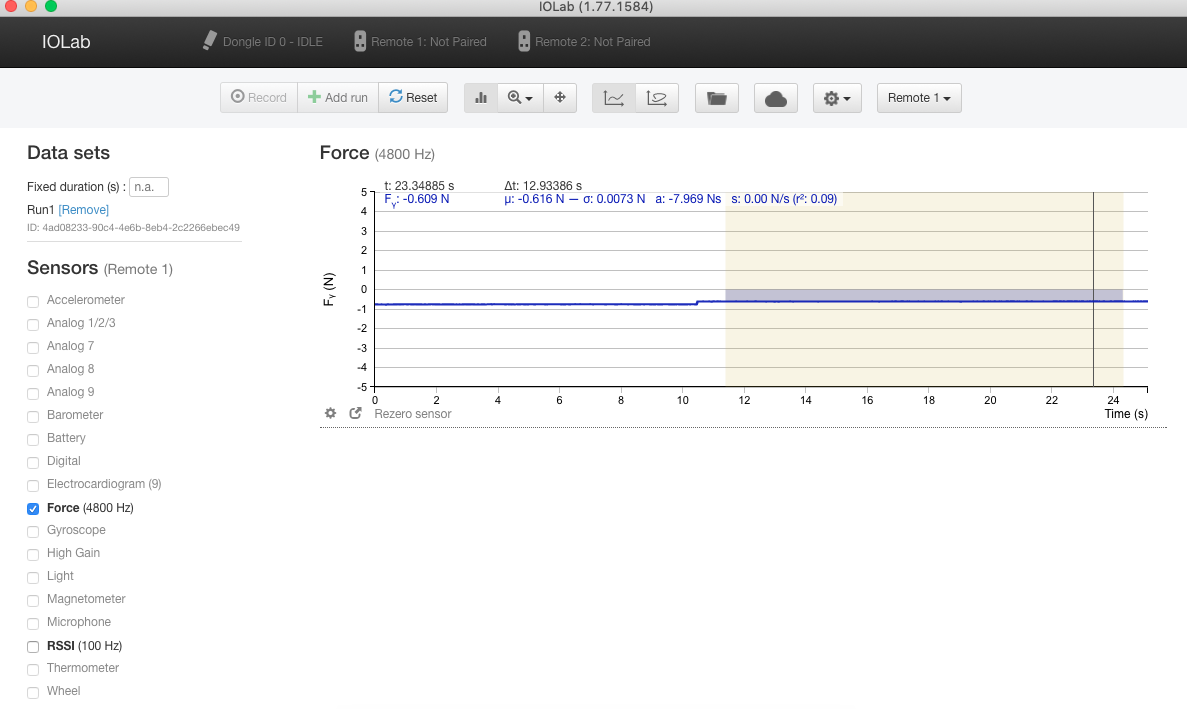
Figure 8 below shows how to select the force sensor data when the pebble is submerged in the water:

determining tension as the average value of the force sensor reading

Fig 8: Select a portion of the force data when the pebble is submerged in water. The average value of the force sensor reading the tension in the string \(T\).

Now that we have determined the string tension when the buoyant force is both present and absent, we are in a position now to determine both the unknown density (\(\rho_0\)) and the unknown volume (\(V\)) of the pebble. Let us first rewrite Eq. \eqref{eq:Tprime} and Eq. \eqref{eq:force_bal2} below:


\[\rho_w V g + T = \rho_0 V g \label{eq:force_bal_again}\]


\[T^\prime = \rho_0 V g \label{eq:Tprime_again}\]


Substituting Eq. \eqref{eq:Tprime_again} into Eq. \eqref{eq:force_bal_again} we can solve for the volume (\(V\)) as:


\[V = \frac{T^\prime - T}{g\rho_w} \label{eq:vol}\]


In order to calculate the volume use \(g=9.8~\textrm{m/s}^2\). We can now determine the density by substituting Eq. \eqref{eq:vol} into Eq. \eqref{eq:Tprime_again} and solving for the density (\(\rho_0\)):


\[T^\prime = g\rho_0 \frac{T^\prime - T}{g \rho_w}\]


\[\implies \rho_0 = \rho_w \left( \frac{T^\prime}{T^\prime - T}\right)\]


In order to calculate the density of the pebble, use \(\rho_w = 1000~\textrm{kg/m}^3\).


Report Considerations

Make sure you include the following in your lab report:

  • Include ONE (1) example snapshot showing your analysis of the data for the string tension without buoyancy (see Fig. 7 above).
  • Include ONE (1) example snapshot showing your analysis of the data for the string tension with buoyancy (see Fig. 8 above).
  • Describe the errors in your measurements.
Questions to answer in the discussion section.
  • What is the unknown density of the pebble?
  • What is the unknown volume of the pebble?
  • Is the experimentally determined value for the density of the pebble a reasonable number?
  • What would happen to the string tension if the pebble were only partially submerged? Answer your question in terms of the two string tensions \(T\) and \(T^\prime\) that you determined.